The Art of the Pennsylvania German Dower Chest: Color, Ceremony, and Cultural Memory in Southeastern Pennsylvania
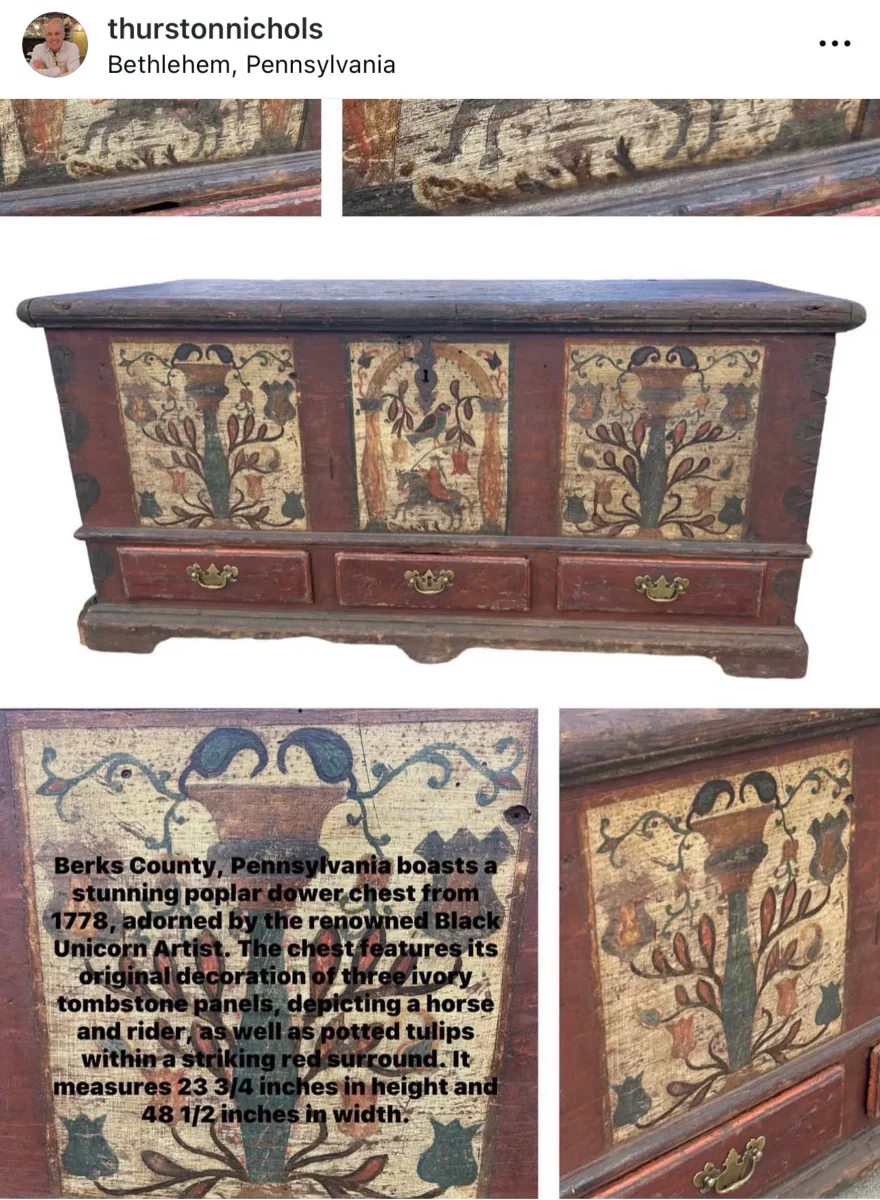
A Pennsylvania German painted chest can appear, at first, to be a straightforward household object: a wooden container with a hinged lid, iron hardware, and enough room for folded textiles.
Look more closely, and it becomes something larger.
The chest records migration, family formation, work, inheritance, regional taste, and the persistence of memory. Its painted surface preserves a visual language that began in the Old World, changed in southeastern Pennsylvania, and survived through generations of practical use.
This is why the Pennsylvania German dower chest remains one of the most compelling forms of early American furniture.
A Chest For The Next Household
The term dower chest is useful, but it requires some care. It is largely a later shorthand. Not every chest was made exclusively for a young woman, and not every date on a chest represents a wedding or marriage.
Pennsylvania German households used chests for clothing, bedding, linens, needlework, money, food, and other personal belongings. Some were given to young people as they came of age. Others were acquired later, inherited, or brought into a marriage household. Surviving examples with male names make clear that the form was not limited to women.
Still, the association with a bride’s trousseau is meaningful. Textiles represented considerable labor and value in an eighteenth- or early nineteenth-century household. A young woman might accumulate blankets, towels, embroidered linens, clothing, and household goods over many years. The chest kept these articles together, protected, and portable as she moved into a new household.
A Pennsylvania German chest could therefore serve several purposes at once:
- Storage for valuable textiles and clothing
- A secure container for smaller possessions
- A visible sign of family provision
- A portable object carried from one home to another
- An heirloom passed through later generations
Its practical role was never separate from its emotional one. The chest held things, but it also held preparation, expectation, and family history.
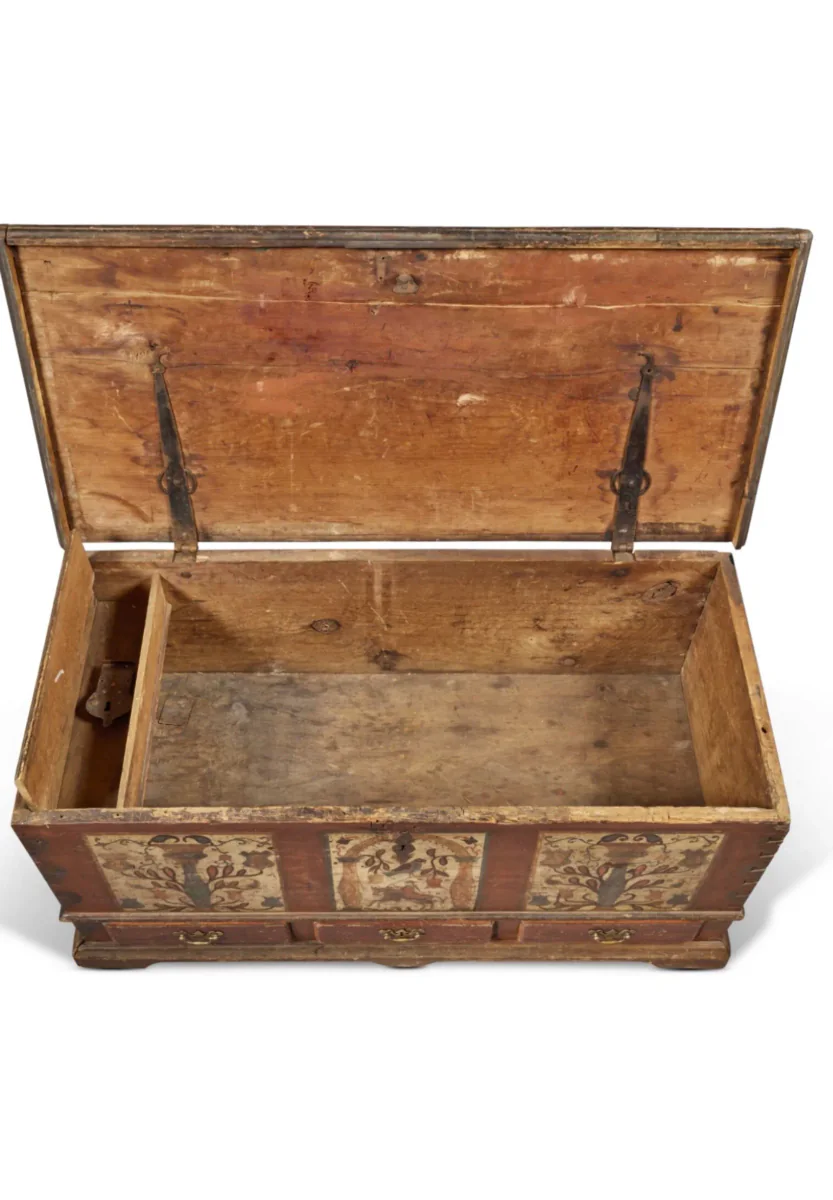
The interior of a painted chest reveals the object’s practical character: a deep storage compartment, a smaller till, hand-fitted boards, and hardware made for repeated use.
Old World Traditions, New World Materials
German-speaking immigrants brought Continental traditions of woodworking, painted decoration, household organization, and life-cycle ceremony to Pennsylvania. These traditions did not remain unchanged.
In southeastern Pennsylvania, local makers worked with native pine, tulip poplar, walnut, and other available woods. They responded to local customers, local churches, local markets, and neighboring communities. The result was not simply European furniture transplanted to America. It was a regional language shaped by adaptation.
The geography is important. Berks, Lancaster, Lebanon, Dauphin, Montgomery, and surrounding counties contained communities of German Lutherans, Reformed families, Mennonites, Moravians, Dunkers, Schwenkfelders, and others. English, Welsh, Scots-Irish, Swiss, Alsatian, and French Huguenot influences were also part of this “great mixed multitude.”
Furniture moved through these communities. Makers relocated. Families intermarried. Designs were copied, adjusted, and reinterpreted. Ownership histories sometimes reveal a more precise regional identity than appearance alone.
This is one of the central lessons of modern scholarship, including the work discussed in Paint, Pattern & People: Furniture of Southeastern Pennsylvania, 1725–1850. A chest should not be assigned to a county only because its decoration resembles a familiar type. Construction, materials, family descent, church records, and documented ownership can all contribute to a responsible attribution.
The Discipline Of Painted Decoration
The painted dower chest is often described as exuberant. That is true, but its decoration is also highly controlled.
Painters organized the façade into panels. Borders established order. Compass lines and straightedges helped regulate stars, rosettes, arches, and geometric divisions. The decoration might include tulips, pomegranates, hearts, birds, animals, riders, urns, trees, architectural scenes, and scrolling vines.
The palette could be equally distinctive. Red, green, blue, yellow ochre, black, and cream were arranged in deliberate relationships. Strong ground colors gave the furniture presence inside a room, while lighter panels created a surface for detailed ornament.
The painting was not always done by the person who built the chest. A cabinetmaker, a decorator, a blacksmith, and sometimes a calligrapher or fraktur artist could all contribute to one object. This division of labor helps explain the remarkable combination of sturdy construction and delicate surface work.
The designs may have been freehand, stenciled, incised, or transferred from patterns. Some painters used repeated forms across several chests. Others developed recognizable variations in lettering, flowers, borders, or animals.
The decoration is best understood as a visual vocabulary rather than a fixed code.
Hearts and tulips may suggest affection or union, particularly in a marriage context. Birds, flowers, and pomegranates can carry long European associations with abundance, fertility, and renewal. Yet the evidence does not support assigning one universal religious meaning to every motif. Scholars have rightly challenged the older habit of interpreting all Pennsylvania German painted furniture as uniformly symbolic or devotional.
Sometimes a tulip was a tulip. Sometimes it was a familiar inherited form selected because it was beautiful, recognizable, and appropriate to the surface.
Fraktur And Furniture
The relationship between painted furniture and fraktur is one of the most revealing aspects of Pennsylvania German visual culture.
Fraktur includes decorated birth and baptismal certificates, bookplates, family records, house blessings, and other works on paper. These documents marked important moments in a person’s life. Their flowers, birds, angels, hearts, architectural scenes, and elaborate lettering often resemble the imagery found on painted chests.
The connection could work in several ways. A fraktur artist may also have decorated furniture. A furniture painter may have copied designs from fraktur. A printed certificate could be pasted beneath a chest lid, where it remained protected from light and handling. In some cases, the relationship is direct; in others, it is a matter of shared regional taste.
Lisa Minardi’s “From Millbach to Mahantongo: Fraktur and Furniture of the Pennsylvania Germans” demonstrates how closely these media could interact while cautioning against easy attributions. Similar flowers do not automatically prove the hand of the same artist.
The connection is cultural as much as technical. Fraktur and furniture belonged to the same world of family records, church life, domestic display, and local craftsmanship.
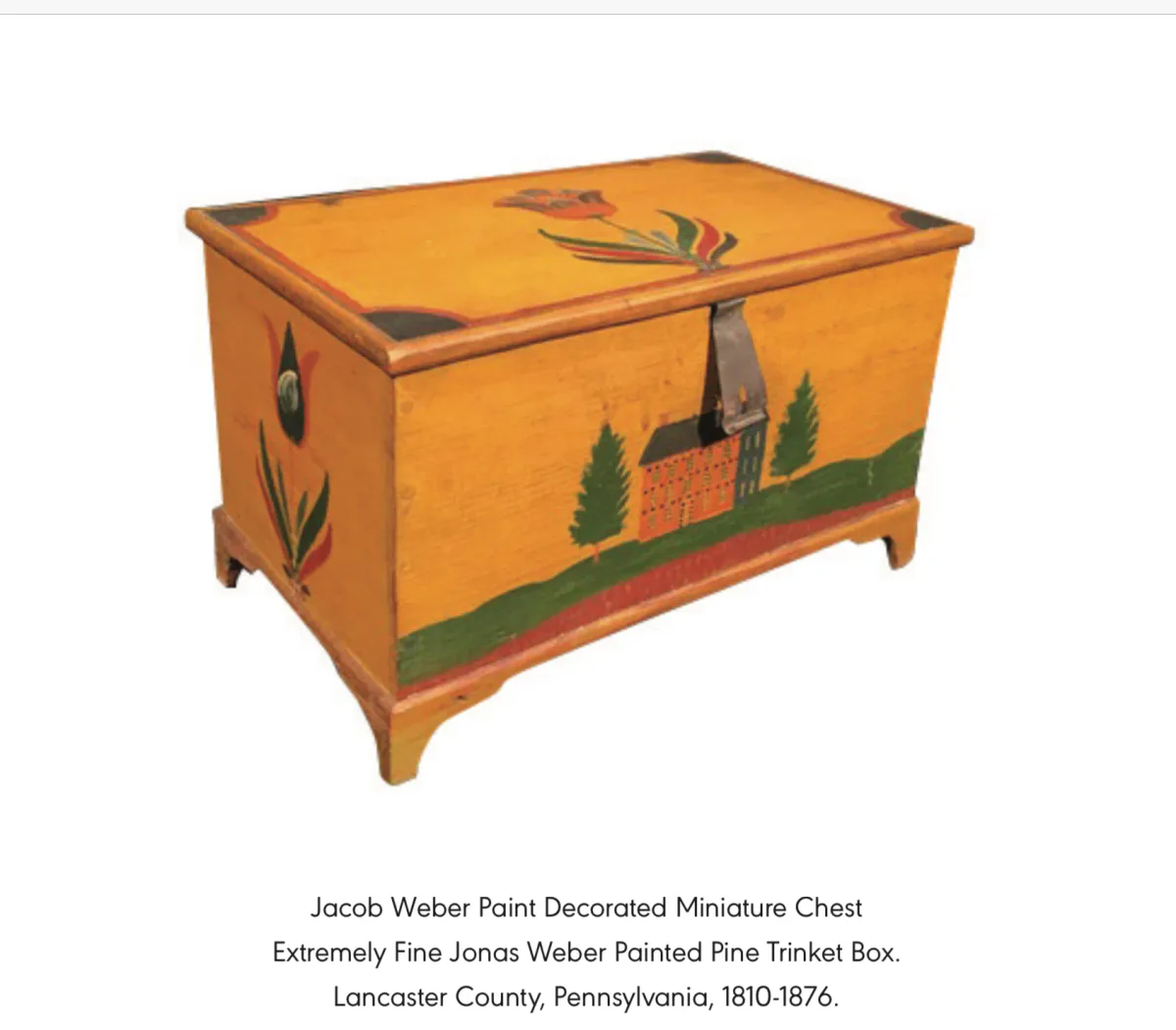
This Lancaster County miniature chest, attributed to the Weber family, extends the painted-chest tradition into a smaller format. Its yellow ochre ground, tulips, architectural scene, and original hardware show how the visual language could be adapted to a compact object.
The Black Unicorn Group
The 1778 Berks County chest shown here is an especially strong example of the regional character of Pennsylvania German painted furniture. Its ivory-toned panels contain tulips, birds, a horse and rider, and other carefully organized forms within a red-painted surround.
It is associated with the group commonly called the Black Unicorn chests of Berks County. The name refers to the distinctive unicorn imagery found on a number of related examples. The group is valuable not because every chest can be assigned to one famous painter, but because it reveals how regional workshops and decorators shared patterns, techniques, and preferences.
Patricia J. Keller’s study, Workmanship, Form and Cultural Identity: The Black-Unicorn Paint-Decorated Chests of Berks County, Pennsylvania, is important precisely because it looks beyond the idea of a single “Black Unicorn Artist.” Construction details, paint handling, and repeated design elements suggest the involvement of multiple shops and decorators.
The unicorn itself should not be reduced to one simple explanation. It belongs to a broader European and heraldic tradition and appears in both furniture and works on paper. In Berks County, it became part of a shared regional vocabulary: an image adapted to local taste and repeated across related objects.
The result is a group identity, not necessarily an individual signature.
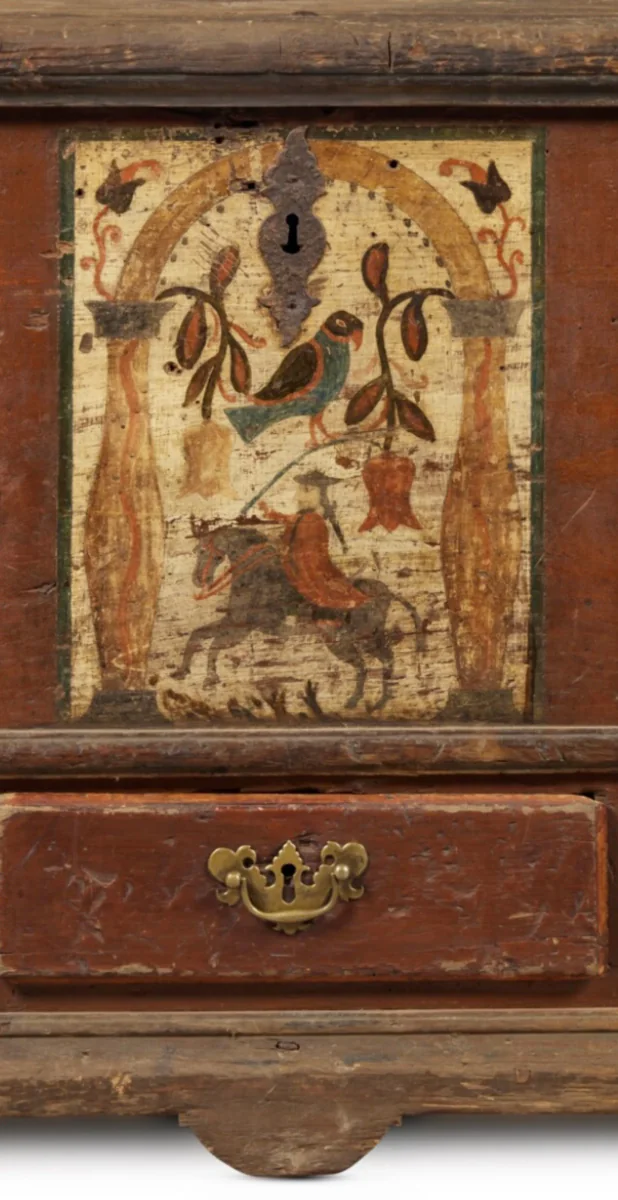
Close detail of the painted surface. Wear, abrasion, softened outlines, and surviving color relationships are part of the object’s history rather than distractions from it.
Construction, Portability, And Inheritance
A serious study of a Pennsylvania German chest begins beneath the decoration.
The choice of wood matters. Pine and tulip poplar were practical regional materials, receptive to paint and suitable for broad boards. Walnut appears on more elaborate examples. Wooden pegs, mortise-and-tenon work, till compartments, shaped feet, iron hinges, locks, and carrying handles all provide clues to workshop practice.
These details also speak to use. A chest with side handles was meant to be moved. A till offered a smaller, more private space within the larger compartment. A lock secured belongings. A hinged lid allowed access without sacrificing the strength of the form.
Some chests were repaired, altered, or fitted with replacement feet. Others retained original hardware or traces of old labels and inscriptions. Such changes do not necessarily diminish their importance. They document continued use.
A chest that remained in a family for generations might be repainted, moved between rooms, repaired after damage, and filled repeatedly with new belongings. Its survival is not a story of untouched perfection. It is a story of persistence.
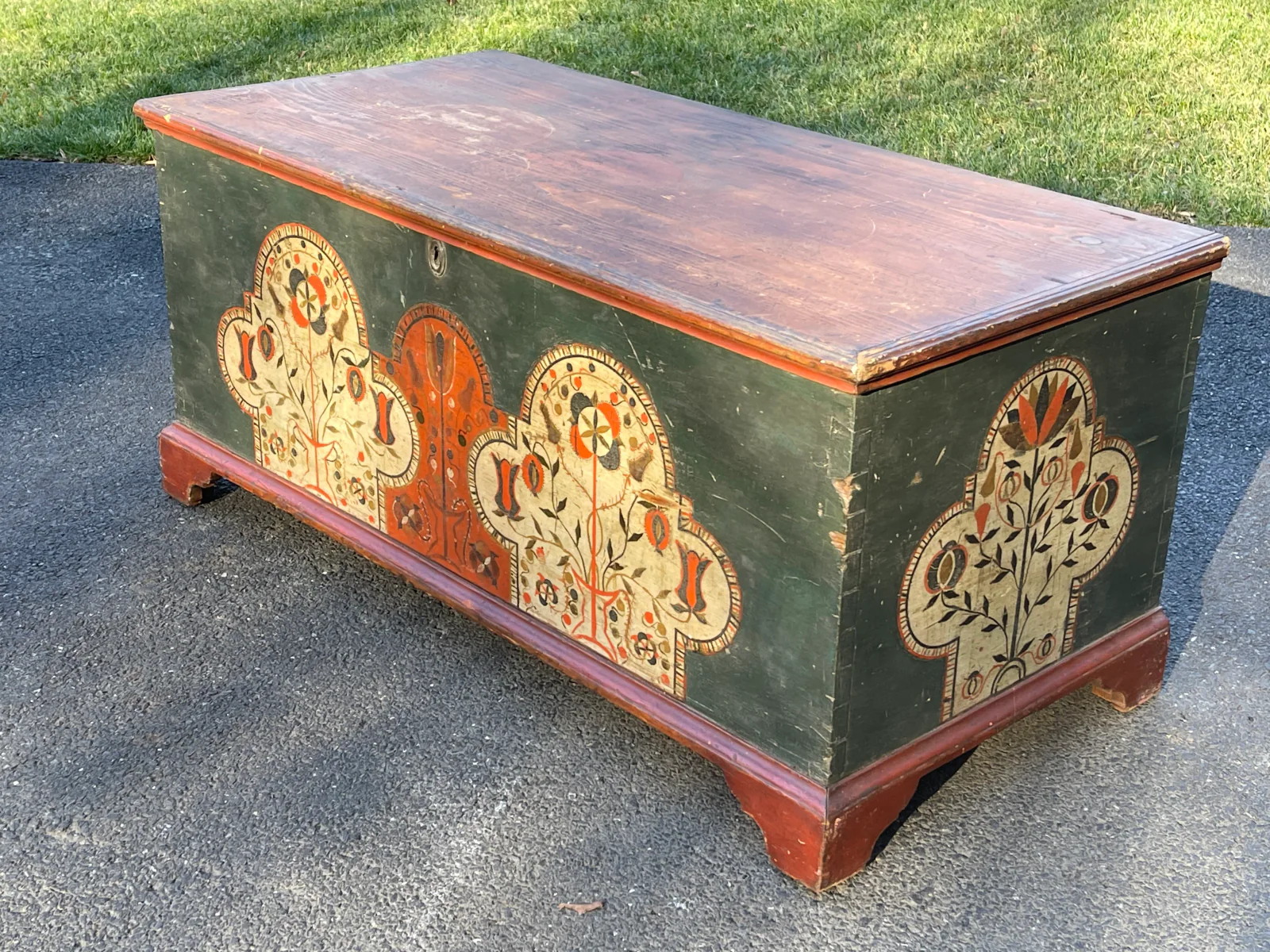
The green painted chest illustrates another regional approach to color: a deep ground, lighter floral panels, and contrasting warm trim. Its decoration should be read as a specific object’s visual language, not as a universal formula.
A Survival Miracle Of Color And Culture
The most moving Pennsylvania German chests are not merely colorful. They are legible.
Their surfaces allow us to see how a community translated memory into material form. Continental motifs were carried across the Atlantic, adapted to local woods and pigments, and reshaped by American workshops. Family names and dates could be written into the design. Fraktur could be placed beneath the lid. Paint could announce a household’s taste and aspirations.
These objects preserve a transitional culture: neither wholly Old World nor simply new. They are records of migration made from local wood, decorated with inherited forms, and used in changing American households.
That is the survival miracle of color, design, and transitional culture. Not that every surface remains bright, but that enough remains visible: original paint, worn edges, altered hardware, repairs, and traces of handling: to keep the past present.
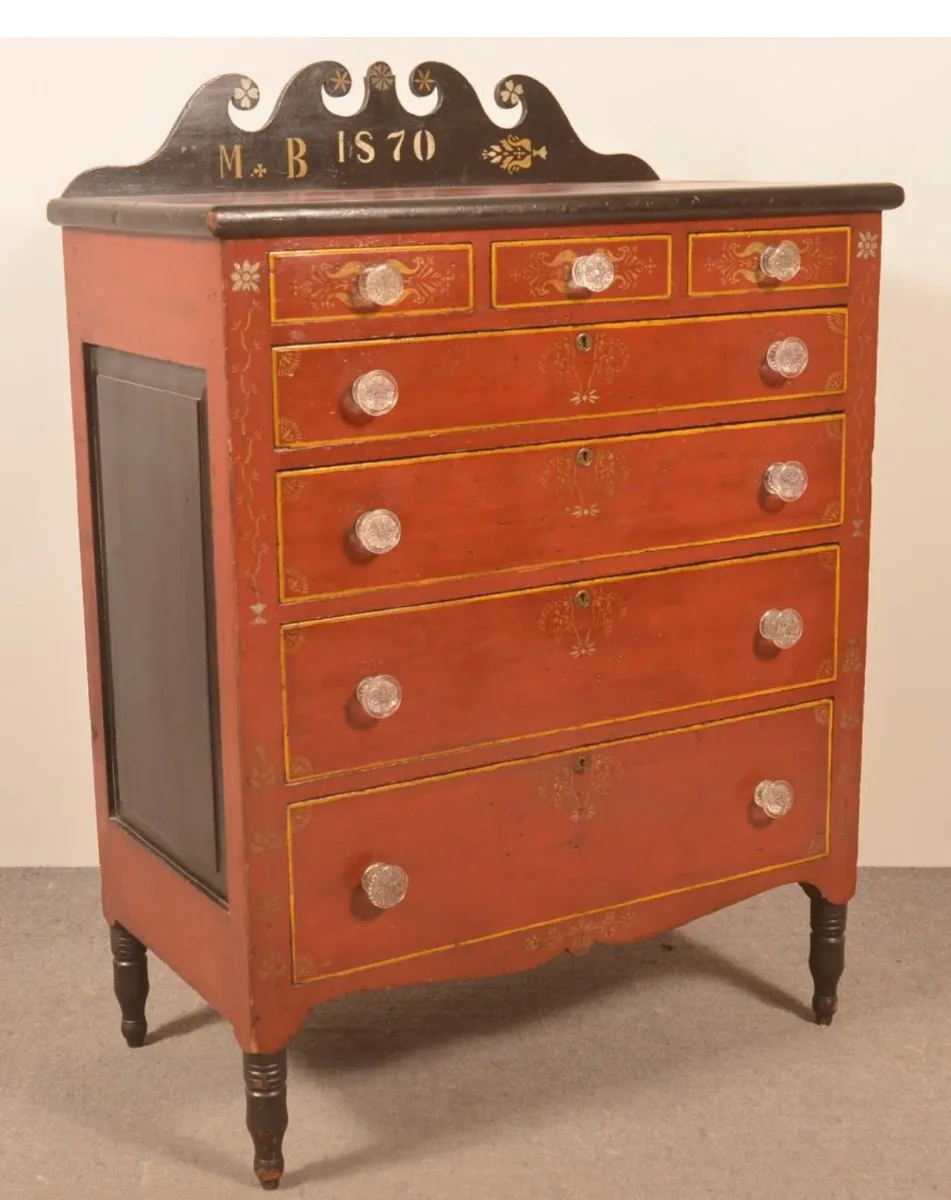
This later painted folk-art chest of drawers shows how the broader tradition of colorful, decorated storage furniture continued beyond the classic eighteenth-century dower-chest period.
Collecting With Context
For collectors, condition and visual appeal are only part of the conversation. Original surfaces, construction, provenance, and regional context deserve equal attention.
A painted dower chest with strong color but extensive repainting should be described honestly. A chest with repairs may still be deeply important if those repairs document long use. A name or family history can change how an object is understood, sometimes more decisively than a stylistic comparison.
The best collections preserve information as carefully as they preserve objects. Photographs, old labels, family papers, auction records, and oral history can all help maintain a chest’s identity.
Further context can be found through the Pennsylvania Heritage article on Mahantongo furniture, the Philadelphia Museum of Art’s 1803 chest of drawers, the PBS Antiques Roadshow discussion of a Pennsylvania dower chest, and The Metropolitan Museum of Art’s related chest.
If you are studying, acquiring, or caring for a Pennsylvania German chest, you are welcome to reach out to Thurston Nichols. A careful, personal conversation can help clarify construction, surface, provenance, and regional character: quietly and with the object’s long history in view.
Further Reading
- Chipstone Foundation : Paint, Pattern & People: Furniture of Southeastern Pennsylvania, 1725–1850
- Chipstone Foundation : From Millbach to Mahantongo: Fraktur and Furniture of the Pennsylvania Germans
- University of Delaware : Workmanship, Form and Cultural Identity: The Black-Unicorn Paint-Decorated Chests of Berks County, Pennsylvania
- Pennsylvania Heritage Magazine : Finding the Fabulous Furniture of the Mahantongo Valley
- Philadelphia Museum of Art : Chest of Drawers, 1803
- PBS Antiques Roadshow : Pennsylvania Dower Chest, ca. 1780
- The Metropolitan Museum of Art ( Chest)